Guide
Roco Kingdom Currencies and Farming Guide
Roco Shells, Diamonds, Starlight and Wish Stars: the free sources, weekly caps, coin machines and what not to buy.
Roco Shells buy almost everything you can wait for; Diamonds buy the things waiting cannot reach. Every other resource here is a bottleneck with a short list of free sources, so the job is not collecting them — it is not wasting them.
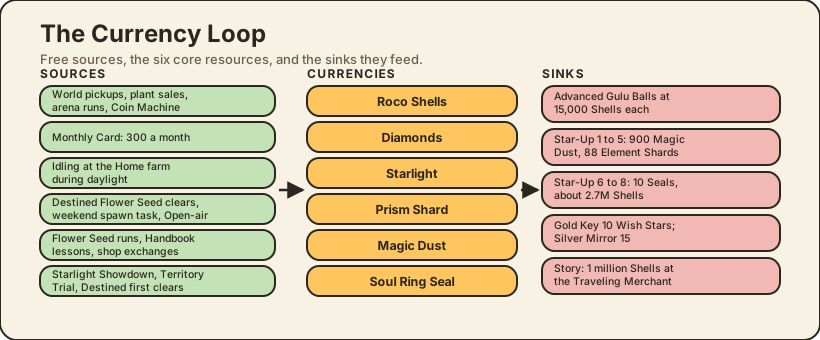
The currency list
Learn each one's purpose first.
| Resource | What it pays for | Main free source |
|---|---|---|
| Roco Shells | Shop stock, ball purchases, Star-Up fees | World material pickups, Home plant sales, arena runs, Coin Machine drawers |
| Diamonds | Premium-only items | Monthly Card (300 a month); otherwise paid |
| Starlight | Background progression income | Idling at the Home farm during daylight |
| Prism Shard | Prism Balls and their contracts | Destined Flower Seed first clears, weekend mass-spawn task, Open-air Challenge |
| Magic Dust | Star-Up, the main PvE bottleneck | Flower Seed runs, Magic Handbook lessons, two one-off shop exchanges |
| Element Shard | Star-Up, one shard type per element | Element Alpha bosses |
| Soul Ring Seal | Six-star and higher Star-Up steps | Starlight Showdown, Territory Trial, Destined Flower Seed first clears |
| Wish Star | Alchemy recipes: keys, mirrors, bloodline potions | Territory Trial, Season Pass, events |
| Contract Essence | The last Star-Up steps | Territory Trial; extremely limited |
| Kingdom Emblem and Unicorn Coin | Shop exchange currencies | Exploration; spend at Vera's Shop and Annie's Shop |
Starlight is the odd one out: posts confirm it builds while you idle at the Home farm, but none list a shop price, so treat it as passive income.
Farming Roco Shells
Shells come from selling what you pick up, not from repeating battles. A wild flower node pays at least 6,000 Shells because it yields at least two blooms, and the collector at your Home buys plants for up to 1.8 million Shells a day; arena runs add up to 3 million, for roughly 5 million a day combined (CN build, Season 3; single source). That ceiling is why "just buy more balls" is realistic once your route is efficient.
- Run material routes with Share-trait Jinies. The Share trait multiplies gathering and stacks across the team, so one flower can turn into dozens of materials (CN build, Season 3; single source).
- Pick up ore as well as flowers. Element Balls need both, and the Traveling Merchant sells ore cheaply enough that buying the daily stock is worth it (CN build, Season 3; single source).
- Hold a friend's hand while catching. Your partner receives the same Shells you do, and both of you get a capture bonus (CN build, Season 3; single source).
- Empty the Coin Machine drawers once. Peter Avenue drawer 3 holds 990,000 Shells, Coco Fruit Plaza drawer 1 holds 120 cocoa fruit, and King's Castle holds 4 King Balls (CN build, launch build; single source). The ancient coins themselves come from the coastal ruins dungeon in the lower-left of the map — walk in, pick up what is on the ground, leave, repeat.
The 990,000 is quest money, not savings: the story asks you to spend 1 million Shells at the Traveling Merchant, and the drawer plus the quest payout covers it (CN build, launch build).
Prism Shards and Magic Dust
These two are the resources players most often conflate. Prism Shards buy Prism Balls; Magic Dust raises star level. They never convert.
Prism Shard income is mostly first-clear money. Clearing a Destined Flower Seed fight with a Jini you have not used there before pays 300 shards, and finishing a family pays 1,200 (CN build, Season 3; single source). The weekend mass-spawn task pays 100 for 20 catches, Open-air Challenge pays a steady trickle, and the Monthly Card adds 4,500 over its cycle (CN build, Season 3; single source for the card figure). For scale, 1,200 shards is close to one Prism Ball (CN build, Season 3; single source).
Magic Dust has two numbers that are often quoted as if they were the same, and they are not. Annie's Shop and Vera's Shop together hand out 3,800 Dust in one-time exchanges, including the spending-tier bonuses below the exchange counter (CN build, Season 3; single source, April 2026). A single Flower Seed run pays 30 Dust (CN build, Season 3; single source, April 2026). The first figure is a one-time windfall; the second is your daily income. Budget from the second.
The sink is steep: the first five star levels cost 900 Magic Dust and 88 Element Shards, six to eight stars cost 10 Soul Ring Seals and about 2.7 million Shells, and six to ten stars cost 35 Seals, 2 Contract Essence and about 6.5 million Shells (CN build, Season 3; single source). Spread across a whole roster, that is not affordable. Pick one or two carries.
Wish Stars, Soul Ring Seals and Contract Essence
Wish Stars feed the Alchemy Pot. A gold key costs 10, a silver mirror 15, and a boss bloodline potion 10 (CN build, Season 3; single source). A Territory Trial clear pays 25, and the Season Pass adds 240 (CN build, Season 3; single source). Because the weekly craft is limited, Wish Stars are rarely the binding constraint — the weekly craft count is.
Soul Ring Seals are the real weekly gate. Starlight Showdown pays 5 a week, Territory Trial pays 8, a single Destined Flower Seed first clear pays 2, and a max-evolution Shiny or Radiant Codex entry pays 1 each (CN build, Season 3; single source). If you are raising a six-star carry, the Showdown is not optional.
Contract Essence is the one resource you should never spend casually. One Territory Trial clear pays a single Essence, and the last Star-Up band needs two (CN build, Season 3; single source). Spend it only on a Jini you are finishing.
What to buy first, and what is a trap
- Advanced Gulu Balls at 15,000 Shells each. They are unlimited, they can be thrown in the field, and they are the default for Shiny hunting. See the Gulu Ball guide for the full tier list.
- Element Ball materials from the Traveling Merchant. Cheap ore plus a Standard Ball gives you type-matched throws that can beat Advanced odds against the right target.
- One-time shop Dust. Clear Annie's and Vera's exchanges before you spend Dust on anything else; 3,800 is several star levels of headroom.
The traps are consistent across posts. Do not pull the gacha; experienced players call it a straight loss (CN build, Season 3; single source). Do not spend the 990,000 on cosmetics. Do not sprinkle Magic Dust across every Jini you catch — the jump past two stars is where casual accounts stall. And do not buy Standard Gulu Balls with Shells when Advanced balls are available at a fixed price.
Kingdom Emblems and Unicorn Coins are exchange tokens for those two shops. Spend them on Dust and star materials, not cosmetics.
Caps, restocks and paid tracks
Starlight Showdown is capped at 50 reward claims a week, with one extra claim after a Starlight-level breakthrough (CN build, Season 3; single source). The Traveling Merchant's stock refreshes every four hours according to one post, so check the map icon rather than assuming a daily reset (CN build, Season 3; single source).
Paid values are included only for reference. The Monthly Card cost 30 CNY for 300 Diamonds, 5 Stamina Stones and 4,500 Prism Shards; the Season Pass cost 68 CNY, or 54 in a friend pair, and the deluxe version 128, or 104 paired, adding a Shiny egg and an extra seasonal ball (CN build; single source, March 2026 prices). Global pricing is not confirmed. The base pass plus the card is the efficient resource pair; deluxe is a collection purchase.
Once your income is stable, the loop is short: farm materials, sell plants, buy balls, spend stamina on first clears. The daily routine turns that into a checklist, and the cultivation guide explains where the Dust and Seals actually go.